Feb 12th 2026
Cat6 vs Cat6A vs Cat7: What Should Integrators Use in 2026?
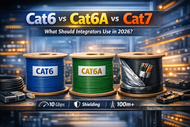
Cat6 vs Cat6A vs Cat7: What Should Integrators Use in 2026?
A Practical Guide for Low‑Voltage Installers & System Integrators
In 2026, structured cabling decisions directly affect PoE performance, 10‑Gigabit links, Wi‑Fi 6/6E capacity, and lifecycle costs. This guide gives integrators, low‑voltage installers, and IT teams a standards‑aligned comparison of Cat6, Cat6A, and Cat7—what each does well, where each struggles, and how to spec the right cable for real projects.
A Clean, Modern Comparison Graphic

Cat6: Common, Cost‑Effective—and Limited for Full‑distance 10G
Performance Overview
- Bandwidth: up to 250 MHz
- Speed: 1 Gbps to 100 m; 10 Gbps typically up to ~37–55 m (environment‑dependent)
- Shielding: mostly U/UTP, some F/UTP options
Best For
- Standard office networks and VoIP
- Basic IP camera systems
- Light PoE deployments
Why It’s Still Popular
- Lower material cost and easy terminations
- Broad hardware compatibility
Cat6A: The 2026 “Sweet Spot” for Performance & Future‑Readiness
Cat6A is the go‑to for modern commercial builds: it’s specified for 10GBASE‑T to 100 m and offers better thermal/crosstalk behavior in dense bundles—ideal for PoE++ and multi‑gig backhaul.
Performance Overview
- Bandwidth: 500 MHz
- Speed: 10 Gbps up to 100 m
- Shielding: U/UTP or shielded (F/UTP, U/FTP)
Best For
- High‑resolution IP cameras (8MP/12MP)
- PoE+ and PoE++ (IEEE 802.3bt) devices
- Wi‑Fi 6/6E access points (two Cat6A drops recommended)
- Smart‑building automation; hospitals, schools, enterprise
Cat7: Specialized ISO Class F Cabling for Harsh EMI Environments
Cat7 (ISO/IEC Class F) is fully shielded (commonly S/FTP). It supports 10GBASE‑T to 100 m, but often requires non‑RJ45 ecosystems (GG45/TERA) and careful bonding/grounding—making it a niche choice in North America.
Best For
- Industrial spaces and heavy‑EMI areas
- Broadcast/AV and specialized government installations
- Installations that mandate maximum noise immunity

Which Cable Should Integrators Choose in 2026?
| Spec | Cat6 | Cat6A Recommended | Cat7 |
|---|---|---|---|
| Bandwidth | Up to 250 MHz | 500 MHz | 600–1000 MHz (Class F/Fa) |
| 10 Gbps Support | ~37–55 m (site‑dependent) | Up to 100 m | Up to 100 m |
| Shielding | Mostly U/UTP; some F/UTP | U/UTP or shielded | S/FTP (always shielded) |
| PoE/PoE++ | Light to moderate PoE | Well‑suited for PoE+/PoE++ (better thermal margin) | Excellent EMI rejection; ensure proper bonding/grounding |
| Best Use Cases | SMBs, VoIP, basic IP cams | High‑res cams, Wi‑Fi 6/6E, smart buildings, enterprise | Industrial, high‑EMI, AV/broadcast, secure facilities |
| Termination/Hardware | RJ45 (ubiquitous) | RJ45 (10GBASE‑T) | Often GG45/TERA or shielded RJ45—verify compatibility |
| Cost & Install Complexity | Lowest cost; easiest pulls | Moderate; thicker jacket & separator | Highest cost; strict bonding/grounding |
2026 Recommendation
For ~90% of commercial jobs, Cat6A is the right choice. It balances performance, PoE++ headroom, and long‑term scalability—especially with Wi‑Fi 6/6E and multi‑gig uplinks.
Most Commonly Installed Today
Cat6 remains widely installed due to cost and compatibility, but adoption is shifting toward Cat6A as PoE++ and Wi‑Fi 6/6E become standard. Consider Cat8 only for short (<30 m) 25/40G rack‑to‑rack links.
Popular Cabling Brands
Consistent quality; strong Cat6/Cat6A portfolio.
Great value in plenum/riser; broad Cat6A lineup.
Reliability in enterprise/commercial; strong plenum options.