Sep 16th 2026
Preparing Commercial Access Control for Shorter Autumn Days

As summer fades and autumn sets in, commercial facility managers and security integrators face a predictable shift in physical security requirements. Shorter daylight hours leave commercial entryways, loading docks, and employee parking areas in darkness for extended portions of the business day.
Reduced ambient lighting inherently increases security vulnerabilities around entry points, card readers, and perimeter gates. Furthermore, as the sun drops earlier each afternoon, access control hardware must work harder: infrared LEDs on cameras run longer, backlit keypads operate continuously, and outdoor locking mechanisms are subjected to fall temperature swings and moisture.
For field technicians and low-voltage integrators, autumn represents a critical window to audit existing access control infrastructure, recalibrate timing logic, and upgrade power systems before winter weather arrives.
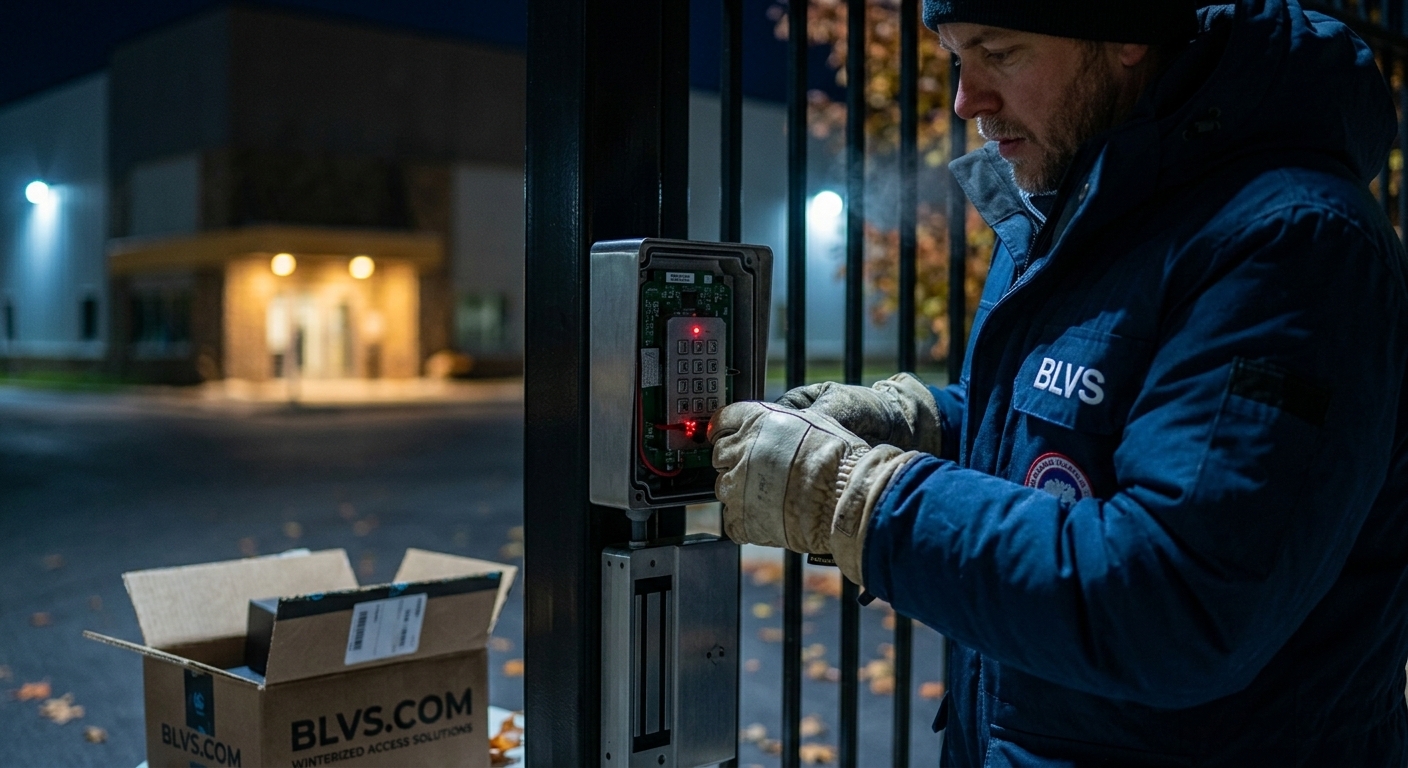 Field technician adjusting outdoor gate access control hardware for early autumn low-light conditions using equipment from BLVS.com.
-
- Auditing Timer Relays & Schedule Recalibration
One of the most frequent service calls in early autumn stems from outdated time-of-day access logic. Systems configured for summer operating hours often unlock exterior doors or illuminate walkways after darkness has already fallen, creating blind spots for staff and visitors.
Integrators should begin an autumn system audit by verifying real-time clock (RTC) accuracy on access control panels and standalone keypads. Internal clock drift can cause unlocked schedules to misalign with actual operational hours by several minutes or even hours over time.
Additionally, static time-of-day schedules should be updated to account for earlier sunsets, or tied into dynamic triggers using multi-function timer relays that interface directly with the main door controller.
AUTUMN ACCESS CONTROL MAINTENANCE CHECKLIST
---------------------------------------------------------------------------------
[ ] Recalibrate panel RTC clocks and check for drift across network nodes.
[ ] Update automated door unlocking/locking holiday and seasonal schedules.
[ ] Inspect outdoor reader gaskets, weather seals, and IP-rated enclosures.
[ ] Test auxiliary lighting relay triggers on valid credential reads.
[ ] Measure voltage drop at long-distance outdoor locking hardware.
[ ] Perform load test on secondary SLA backup batteries under full night draw.
---------------------------------------------------------------------------------
-
- Integrating Photocell Sensors vs. Astronomical Clocks vs. Software Scheduling
To ensure exterior entryway lighting and credential reader backlights operate efficiently without wasting power during daylight hours, integrators utilize three primary automation methods. Selecting the right control mechanism depends on the site architecture, budget, and access panel capabilities.
Comparison Chart: Exterior Access Control & Lighting Automation Methods
| FEATURE/CRITERIA | PHOTOCELL SENSOR INTEGRATION | ASTRONOMICAL CLOCK RELAY |
SOFTWARE BASED PANEL LOGIC |
| TRIGGER MECHANISM | Ambient Light Level (Photodiode) |
Solar Position Calculator (Latitude/Longetude) |
Programmed System Schedule |
| WEATHER DEPENDENCY |
Responds Dynamically to heavy overcast or dark storms | Ignores weather, Strictly solar/calendar based |
Ignores weather, Requires manual adjustment |
| MAINTENANCE NEED | High(Lens cleaning, Dust/Debris Clear) |
Low (Battery Backup for internal Clock) | Low (Software updates and NTP Sync) |
| FAIL SAFE MODE | Closes Dry Contact on Dark/Sensor Failure | Operates via preprogrammed calendar |
Dependent on Network/Panel Uptime |
| BEST USE CASE | Unpredictable climates, isolated perimeter gates | Retrofits without Cloud Panel Integration |
Integrated commercial facilities with IP Panels |
When integrating photocells or astronomical clock relays with access control systems, wire the auxiliary output of the lighting relay into a dry contact zone input on the access controller.
This allows the panel to execute custom macro logic - such as increasing camera frame rates, turning on auxiliary LED floodlights, or enforcing multi-factor authentication (card + PIN) specifically during night hours.
-
- Upgrading Lock Hardware & Exterior Reader Infrastructure
- Upgrading Lock Hardware & Exterior Reader Infrastructure
Autumn weather brings moisture, falling leaves, and temperature swings that test exterior door hardware. Rain and condensation entering unsealed lock body cavities can lead to premature coil failure or short circuits in non-rated electric strikes.
Integrators should inspect all perimeter doors for proper weather stripping and moisture ingress protection. Ensure that all exterior entryways feature heavy-duty, outdoor-rated electric strikes rated for IP65 or higher, equipped with internal solenoid surge protection.
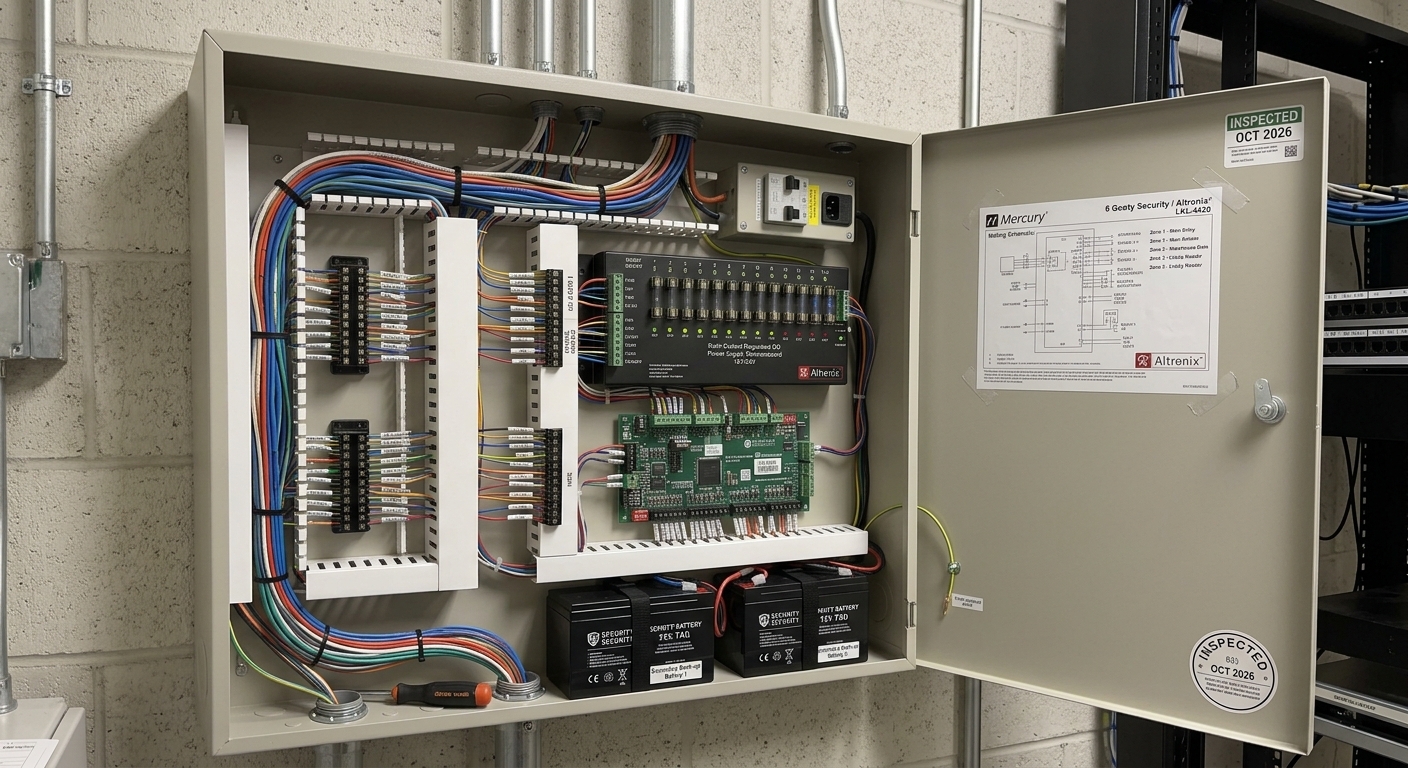 An open, wall-mounted, grey metal commercial security and access control system cabinet.
-
-
- Sizing Auxiliary Power Supplies & Battery Backup
- Sizing Auxiliary Power Supplies & Battery Backup
-
Longer autumn and winter nights mean peripheral devices operate at maximum power consumption for 12 to 14 consecutive hours.
Infrared camera illuminators, reader backlights, keypad heaters, and continuously energized fail-safe magnetic locks increase the total continuous current draw on power supplies.
A power supply that operates nominally during 8-hour summer nights may overheat or suffer excessive voltage drop under prolonged nighttime loads. When auditing or designing an autumn upgrade:
-
- Calculate Peak Continuous Draw:
Add the maximum current consumption (in Amps) of all connected readers, locking devices, auxiliary relays, and illuminators operating simultaneously at night. - Account for Voltage Drop:
Measure the DC voltage at the furthest door location while all nighttime loads are active.
Long wire runs (18/2 or 22/6) may drop below the lock’s minimum operating threshold (e.g., dropping below 10.8V on a 12V DC strike), causing lock chattering or failure to latch. - Inspect Backup Batteries:
Cold weather degrades Sealed Lead-Acid (SLA) battery chemistry rapidly.
Perform a load test on all stand-by batteries to ensure they can maintain system operation during seasonal power outages.
- Calculate Peak Continuous Draw:
To prevent system downtime, utilize high-efficiency multi-output access control power supplies equipped with independent fused or PTC-protected outputs, PTC thermal shutdown protection, and dedicated battery charging circuits.
Conclusion:
Partnering with BLVS for Seasonal Upgrades
Preparing commercial access control systems for shorter autumn days is an essential preventive maintenance practice that protects facility assets, ensures life safety code compliance, and prevents emergency late-night service calls.
By auditing schedules, upgrading outdoor hardware, and verifying power supply capacity today, integrators deliver reliable, round-the-clock protection for their clients.
At BLVS.com, we stock the trade-grade low-voltage equipment, access control hardware, power supplies, and cabling you need to execute seamless seasonal upgrades.
As your wholesale distribution partner, we deliver The Connections You Count On - with competitive trade pricing, deep inventory levels, and fast shipping.